
March 23, 2026
Reducing Insulin Growth Factor 1 (IGH1) in the diet slows and can reverse PCa progression.
I have been aware of this since my daughter bought me the book, How Not to Die: Discover the Foods Scientifically Proven to Prevent and Reverse Disease, by Michael Greger, M.D. There is a chapter on specific information for PCa, and it was there that I first learned about IGH1. Clearly from his information, IGH1 in the bloodstream is something to avoid, but since the book is older, I thought I would refresh my information about IGH1 and see how my diet is aligning with that.
The short story told from my recent re-researching here confirms that I mostly getting it right. My Vegan Diet covers most aspects of IGH1 reduction. Although fasting intermittently, using olive oil, and frying in avocado oil also helps. I am already exclusively using olive oil, but now I am switching to avocado oil for any high heat cooking because avocado oil has a higher smoke point. I have intermittently fasted for up to 24 hours, but some recommendations call for 72 hour fasting to lower IGH1 blood concentrations even more significantly. Keto-style, low carb diets, also help lower IGH1, and for me, it keeps me from feeling hungry, especially for 24 hour fasts. I will have to try a 72 hour fast and see how that goes.
March 21, 2026
Breaking barriers in prostate cancer: the mRNA vaccine breakthrough and what comes next
Here is a fantastic anti-PCa paper published in the journal, Nature, arguably the most prestigious science journal in the world. I find it fantastic because it confirms to me that my approach to fighting PCa may very well be the best one for me, because the research has been moving in the right direction.
Why I chose this direction
Please allow me to digress and discuss how I came up with this approach and what happened along the way that cemented it in my brain. After almost one year of my own independent research on fighting PCa and watching my PSA drop in half from 6.4 to 3 (see my Months 0 through Month 12 part of the site), I sat down to dinner with my relatives at Thanksgiving. Afterward, I casually asked a nephew how things were going at work, and that began a conversation with a reminder by him that he works at a large pharmaceutical firm. “I’ve been involved with some new cancer research. I have been running some early human testing on some new therapies involving immune therapy.”
Well, that got my attention, and I mentioned what I knew about CRISPR technology and continued by asking if CRISPR was involved with what he was doing. He said it certainly was, in-fact that was exactly what he was doing (it was not for PCa unfortunately and I’m going to have to ask him if it’s ok to reveal more particulars than I already have here).
He went on to say that it was going quite well, where over 80% of the patients were getting cured! The biggest problem he was having was liver issues, where subjects’ livers were being flooded with dead cancer cells! He also said its a painstakingly difficult and expensive process (2 years ago now). I questioned him on how one might get into such a trial program, and he said he did not know the specifics of that, but that it was such a shame that the only patients he was getting where those who had exhausted all other avenues of treatment. His subjects had been through the ringer already. “Such a shame, it’s too bad that the patients couldn’t be brought into this treatment earlier, before the debilitating and irreversible side effects where already experienced.”
After hearing that, I wanted to become “one of those patients who could get a CRISPR-based anti PCa treatment before experiencing any of the traditional therapies. I guessed that could be 5 to 10 years, or even longer. Maybe I couldn’t make it that far. But I am using my research-based vegan diet and anti PCa supplement approach to slow it down, maybe reverse it some, to give me the best chance.
Anyhow, that is how I changed what I eat, drink, and breathe, to either slow or stop the advance of my PCa, and give the mRNA solutions to reach the general public. Or perhaps I could get myself into a trial.
Big Boost for mRNA research
mRNA-vaccine-style therapies received a tremendous boost due to the research and development of COVID-2 mRNA vaccines. These vaccines boosted our immune system so they could ‘seek and destroy’ the COVID-2 virus. More specifically, the process involves reading the DNA of the COVID-2 virus and using CRISPR technologies to create mRNA snippets that could be combined with our white blood cells in our immune systems to quickly detect COVID-2 and kill it.
The COVID vaccines continue to be reinvented to fight the evolving properties of the various COVID viruses that the original COVID-2 has been morphing into. As these iterations of new COVID vaccines have become more routine, scientists have been turning the mRNA vaccine technologies toward fighting cancers, and in particular PCa.
Breaking barriers in prostate cancer: Continued
We need new approaches to fight PCa
We need new methods to fight PCa, or as the paper puts it,
“Thus, there remains an urgent need for novel therapeutic strategies that can effectively target advanced PC while minimizing systemic toxicity4,5.” (1)
Their reasoning behind it comes from the very same information I have been writing about with respect to my lack of desire to go ahead with either radiation, surgery, or traditional chemotherapy. Because as I have come to learn over the 2 or 3 years of my intense study of PCa research, as well as any actual data I can come across, which I find very difficult to find, these traditional therapies are both debilitating and less effective than one might hope. But instead of me saying it myself, I will leave it to this paper to say it for me.
” Despite significant advancements in conventional therapies, including surgery, radiotherapy, chemotherapy, hormonal therapy, and targeted therapy, the clinical management of PC continues to face challenges2,3. High rates of recurrence, metastatic progression, and the unavoidable onset of therapeutic resistance underscore the limitations of current approaches. These hurdles are particularly evident in metastatic castration-resistant PC (mCRPC), where the disease often exhibits aggressive biological behavior, immune evasion, and a poor prognosis. “
I will continue this section as I read more of the paper so I can summarize it here.
For those who might wish to read if for themselves, here it is again. Feel free to post your findings !
If you are interested in what I am doing, Food and Supplements wise to have initially lowered my PSA and improved my MRI results, Look Here.
March 19, 2026
Took time out today to look at the website statistics. The site appears to be getting quite a few hits. I decided to post this for others.
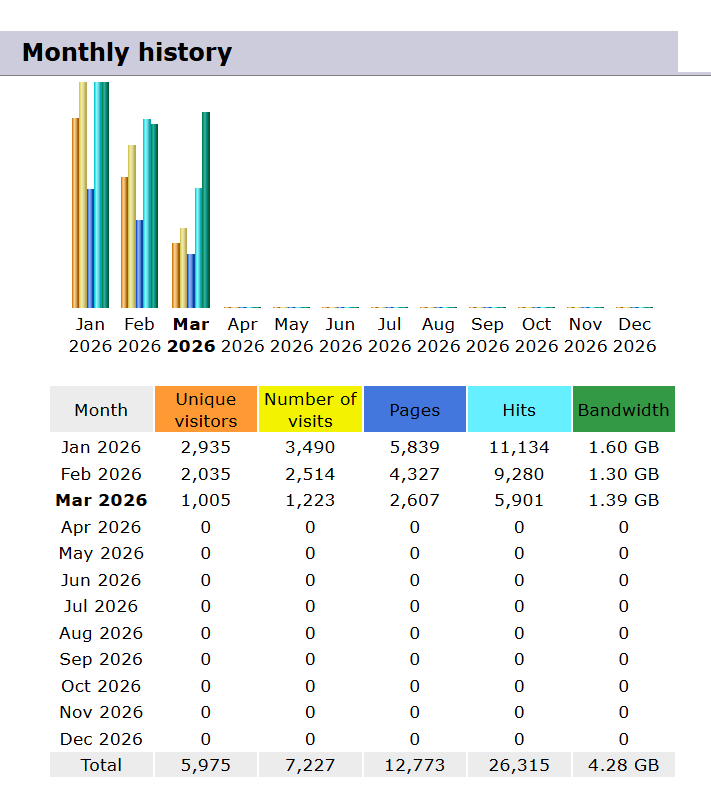
So for Jan Feb and March this year, about 6k visitors or about 75 visitors a day for 80 days. Not to many people comment or send emails however.
Quite a few people stay for a while and look things over, as seen here:

From this it seems the average person stays about 5 minutes. Hopefully some people find the site interesting and/or useful.
Everyone have a great day, and have Great Science behind you.
March 15, 2026
OK, then. It has been a while since I have posted. My priorities have shifted. My anti PCa protocol seems to be working, and other things are cropping up that need attention also. Welcome to the Ides of March !
I had to make an emergency trip to The Philippines and will remain here until Mid April. I do have a reliable internet connection right now, so it’s time to recap or discuss new things that I learned or that I am thinking about.
What do Microplastics have to do with PCa?
At first examination, someone linked a publication that showed that 2.5 times the concentration of microplastics were found in PCa tissue when compared to healthy prostate tissue. Thankfully, I have been out in front on this issue for more than 2 years now. Please see my Air, Water, and Food Strategy. I will try to get back to here in the post and create a summary for easier reading than my journaling might be.
Colonoscopy first, MRI after
I know my annual MRI can be scheduled when I come back in April, and will be set up for May. But my 5 year colonoscopy comes first since I haven’t had one in 9 years or so. I know colon cancer will take me out a lot faster than PCa will. And somewhere soon in the mix is my Apigenin self study.
Nice Emails
I received a few nice emails showing other appreciate what I am doing. Here are three of them. Thanks for that emotional boost. It makes all the work I put into this site worth it. I also suspect some others who read the site may find it useful, but haven’t reached out, which is fine.
Hello,
Thank you very much for the website you created. I have some prostate
issues and found your website by chance. My PSA is elevated and not
official diagnostic yet, although I suspect enlarged/inflamed
prostate.The info you put in there is a goldmine. Please continue the good work
and I pray that you stay healthy.
Next email:
My scenario:
I’m late 40’s y.o. just got my 2nd PSA test results back and they doubled in last 12 months!
Had MRI a year ago, prostrate was v.large, did fusion biopsy, Pi-rad 3 &4. Everything begnin. Now these psa results !
Thanks for your post!
Next email:
Hello Patrick,
First, a big thank you for putting together all of the incredible information and making it accessible to those of us on the Active Surveillance road of our PCa journey. I’m glad I came across your postings while looking through the PCa Reddit community.
What just happened there?
I cut and pasted each email content separately, and have no idea why one was surrounded by a box, and the others, not. I do know about computers quite a bit, but know less about Word Press and how it interacts with my web hosting environment.
I will say it’s encouraging to receive positive emails and know that some are finding what I am writing about helpful. Please email me at admin@iloweredmypsa.com if you feel like sharing your story, have a question, or just wish to make a comment. Of course you may also post whatever you like on this blog-style website and everyone can see what you put out there.
I do have more to say and I want to read the microplastics article in detail. But I want to get this our there for now, and I’m being called away from my computer for another urgent local happening. Hope to get back to my computer soon.
Best of Science for Everyone !
Leave a Reply